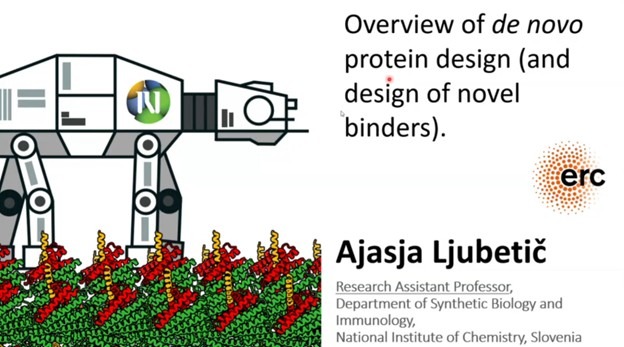
Imagine if we could design the “building blocks” of life just like we design a new house or a car. Instead of relying on what nature has given us through millions of years of evolution, what if we could build entirely new machines at the microscopic level?
In the last CTGCT Science Talk webinar we hosted on the 2nd of March, Dr. Ajasja Ljubetič, a Research Assistant Professor at the Department for Synthetic Biology and Immunology at the National Institute of Chemistry in Slovenia, shared how his team is doing exactly that. Dr. Ljubetič, who previously worked in the laboratory of Nobel Laureate Professor David Baker, is now leading the PROPEL project, funded by a prestigious ERC Consolidator grant. His mission? To use artificial intelligence (AI) to design “de novo” proteins, proteins designed from scratch that have never existed in nature, that can move and perform work.
What is De Novo Protein Design?
In your high school biology class, you likely already learned that proteins are the workhorses of the cell. They carry oxygen, build muscles, and act as enzymes to speed up chemical reactions. Usually, scientists study proteins found in nature. However, de novo design turns this around: we start with a goal, like a specific shape or a task, and then use computers to figure out the exact sequence of amino acids needed to build it.
As Dr. Ljubetič explained, “De novo designed proteins are super cool and they can do everything that natural proteins do and much more”. Because we design them from the ground up, we can make them more robust, more heat-resistant (“thermostable”), and perfectly suited for jobs evolution hasn’t tackled yet.
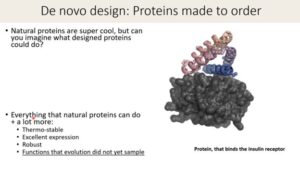
The field of protein design has seen a massive “revolution” recently, jumping from just a handful of designed proteins in the year 2000 to more than 1500 today.
Dr. Ljubetič’s lab uses several cutting-edge tools:
- RFdiffusion: Think of this as “DALL-E for proteins.” Just as AI can generate an image of an astronaut on a horse from random noise, RFdiffusion can “conjure up” a brand-new protein structure from scratch.
- ProteinMPNN: Once the AI has a shape, this tool acts as the “sequence designer,” picking the best amino acids to ensure the protein is stable and easy to grow in a lab.
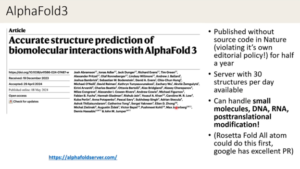
- AlphaFold: This famous tool (which earned its creators a Nobel Prize in 2024) is used as a “final inspector” to check if the computer’s design will actually fold into the right shape in the real world.
Why Does This Matter? Real-World Examples
These scientific discoveries are already stepping out of the computer and into the real world, starting with how we fight global pandemics. For instance, the de novo designed COVID-19 vaccine, SkyCovione, represents a major leap in medical accessibility. Unlike mRNA vaccines that require ultra-cold storage, in this vaccine custom-built proteins were designed to be incredibly stable. This “thermostability” means they don’t need a constant “cold chain” of refrigerators, making it much easier to distribute life-saving medicine to remote or developing areas of the world.
Beyond prevention, designed proteins are improving how we detect illness through highly specialized “molecular lockers.” These are essentially protein traps that stay shut until they encounter a specific target, such as a piece of the SARS-CoV-2 virus. Once the trap is sprung, the protein “unlocks” and creates a visible light signal. This allows for the creation of incredibly sensitive diagnostic tools that can identify pathogens faster and more accurately than ever before.
The ability to sense and respond to the environment is being pushed even further with the development of protein walkers. As Dr. Ljubetič explained, these are essentially microscopic robots made of protein that can physically walk along a molecular track. Imagine a fleet of these walkers programmed to make microscopic repairs on damaged cellular structures from the inside out.
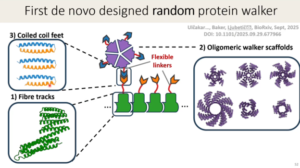
Finally, the impact of this technology extends beyond human medicine to the health of our entire planet. By redesigning natural enzymes to be far more robust, scientists have created versions that can survive extreme temperatures, sometimes up to 35°C hotter than their natural counterparts. Such enzymes could open the door to industrial-scale solutions for the climate crisis, such as breaking down tough plastics in recycling plants more efficiently or capturing carbon dioxide directly from the atmosphere to help cool our warming world.
Designing for Everyone: The ProSculpt Pipeline
While protein design used to require expert coding skills, Dr. Ljubetič is working to change that. His team has developed ProSculpt, a toolkit available on GitHub that aims to make these powerful AI tools accessible to non-computational scientists.
“The barriers to protein design are lower than ever,” said Dr. Ljubetič. By making these tools easier to use, the National Institute of Chemistry is helping scientists around the world design the next generation of life-saving medicines and sustainable materials.
The world of synthetic biology is moving fast. From designing new binders for therapies to building nanomachines, the possibilities are limited only by our imagination. We would like to extend our sincere thanks to Dr. Ajasja Ljubetič for his inspiring contribution to our CTGCT Science Talk series, and we are pleased to announce that the full recording of his presentation is now available for everyone to watch. To learn more about Dr. Ljubetič’s research and the PROPEL project, visit ljubetic-lab.si or follow him on Linkedin or X/twitter.