What if one of the biggest obstacles in gene therapy could be solved by borrowing a concept from everyday life? Just as Velcro joins two separate pieces together to create a strong and functional connection, researchers are now using molecular “Velcro” to assemble powerful genome-editing tools directly inside cells. This elegant idea could help overcome one of the major limitations preventing advanced gene-editing therapies from reaching more patients.
Recently a commentary article by our colleagues Prof. Roman Jerala and Assist. Prof. Duško Lainšček was published in Nature Communications titled Molecular Velcro for Precision Genome Repair. The article highlights an innovative genome-editing platform developed by Mu and colleagues. The work demonstrates how engineered protein interactions can enable the delivery of highly efficient base editors while opening new possibilities for safer and more flexible therapeutic genome engineering.
Key concepts: understanding the science behind the breakthrough
Before exploring the innovation, it helps to understand a few important concepts:
- CRISPR genome editing: A technology that allows scientists to target specific DNA sequences and make precise genetic modifications.
- Base editing: An advanced form of genome editing that changes individual DNA letters without cutting both strands of DNA. This reduces the risk of unwanted genetic alterations.
- AAV (adeno-associated virus) vectors: One of the most widely used delivery vehicles for gene therapies. A major limitation is their relatively small cargo capacity.
- Coiled-coil proteins: Engineered protein pairs that recognize and bind each other with remarkable specificity, much like molecular Velcro.
- Split base editors: Genome-editing tools divided into separate components that can be delivered independently and reassembled inside cells.
These concepts form the foundation of the new approach described by Mu and colleagues and discussed by our colleagues.
Solving a major delivery challenge in genome editing
Base editing has emerged as one of the most promising technologies for treating genetic diseases. Unlike traditional CRISPR systems that create double-stranded DNA breaks, base editors directly convert one DNA base into another, allowing highly precise correction of disease-causing mutations. Many inherited disorders, cancers, cardiovascular diseases, and infectious diseases could potentially benefit from this approach.
However, there has been a persistent problem: size.
Many of the most efficient base editors are too large to fit into AAV vectors, which remain among the most clinically relevant tools for delivering genetic medicines to tissues throughout the body. Researchers have developed several strategies to address this issue, but these often involve compromises in efficiency, flexibility, or engineering complexity.
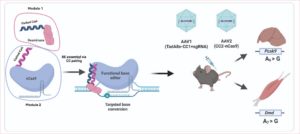
The new solution uses engineered coiled-coil protein pairs as molecular connectors. Instead of delivering one the full DNA sequence that codes for a large editor, researchers divide the code of the editing system into smaller modules that fit inside separate AAV vectors, in this case 2 modules. Once both components enter the cell, the DNA code is translated into proteins. These 2 new proteins are the modules of the editor and since they include matching coiled-coils these promotes their assembly into the complete functional editor.
More than a delivery solution
One of the most surprising findings highlighted in the commentary is that some of the split editors actually performed better than the original full-length versions. Certain coiled-coil cytosine base editors achieved editing efficiencies up to 9.6 times higher in human cells and 12.4 times higher in pig cells.
Why would splitting an editor improve its performance?
The authors of the paper discuss how programmable protein assemblies may create more favorable spatial arrangements between different protein components. Structural modeling suggests that the coiled-coil architecture can position catalytic domains in ways that enhance their activity. In other words, assembling a tool (the split editor) from separate pieces (the proteins) may sometimes be better than building it as a single continuous protein.
This observation introduces an exciting new design philosophy for genome engineering. Future editors may no longer be optimized solely by altering individual proteins; instead, scientists may engineer how multiple molecular components assemble and interact inside living cells.
From laboratory innovation to therapeutic applications
The therapeutic potential of this technology was demonstrated in several important animal studies. Researchers used dual-AAV delivery to achieve highly efficient editing of the PCSK9 gene in mouse liver, reaching editing frequencies approaching 79%. Since PCSK9 plays a key role in cholesterol regulation, such results reinforce the promise of base editing for cardiovascular diseases.
Even more compelling was the application to Duchenne muscular dystrophy (DMD), one of the most severe inherited muscle disorders. Using a coiled-coil adenine base editor delivered through two AAV vectors, the researchers restored dystrophin expression in a mouse model of DMD. This is particularly significant because muscle tissue remains one of the most challenging targets for gene-editing therapies.
The study suggests that molecular assembly approaches could help bring advanced genome-editing therapies to tissues that are currently difficult to target while maintaining the high efficiency needed for clinical benefit.
Toward a new generation of modular genome engineering
Perhaps the most important message from the original article is that it represents a shift toward modular genome engineering. Rather than viewing genome editors as single molecular machines, researchers can now think of them as collections of independently engineered modules that assemble when and where they are needed.
This opens several exciting possibilities. Future editing systems could be designed to assemble only in specific cell types, respond to disease-related signals, or provide tighter control over editing activity. Modular assembly may also improve safety by reducing unwanted editing events and enabling more sophisticated therapeutic architectures.
Importantly, the strategy is not limited to base editing. Similar coiled-coil-based approaches are already being explored for other genome-editing technologies, including prime editing, suggesting that programmable molecular assembly could become a general platform for next-generation genetic medicines.
Looking ahead
While challenges remain, including the need for efficient delivery of multiple vectors and continued optimization of safety profiles, the work highlighted by Roman Jerala and Duško Lainšček demonstrates how synthetic biology can provide creative solutions to long-standing problems in therapeutic genome engineering.
Harnessing programmable protein interactions as this “molecular Velcro” allows researchers to build genome editors that assemble themselves inside cells, creating a new generation of flexible and adaptable editing tools. This not only addresses an important delivery bottleneck but may also redefine how future gene and cell therapies are designed.