CRISPR technologies can rewrite a disease-causing DNA sequence, switch a gene off, correct a single genetic letter or even alter gene activity without changing the underlying DNA. Yet a genome editor can only work if it reaches the right cells, enters them successfully and remains active for an appropriate length of time. In many organs, this journey is now a greater challenge than the editing itself.
Our colleagues at the CTGCT, Tjaša Lapanja and Duško Lainšček, contributed to a new comprehensive review published in the International Journal of Biological Sciences by members of the COST Action Genome Editing to Treat Human Diseases (GenE-HumDi), with Duško Lainšček serving as the corresponding author. Buckle up because this is going to be a long breakdown with a lot of new things to learn.
Key concepts
- CRISPR-Cas system: A programmable molecular tool that uses a guide RNA to direct an editing protein to a selected genetic sequence.
- In vivo genome editing: Editing performed directly inside a patient’s body, rather than in cells removed and modified in a laboratory.
- Ex vivo genome editing: Cells are collected from a patient, edited outside the body, tested and then returned to the patient.
- Base editing: A CRISPR-derived method that can change selected DNA bases or “letters” without creating a double-strand break.
- Prime editing: A versatile “search-and-replace” approach capable of making all 12 possible DNA base or “letter” substitutions, as well as selected small insertions and deletions.
- Epigenome editing: Modification of how strongly a gene is activated or repressed without changing its DNA sequence.
- Adeno-associated virus, or AAV: A widely used vector (or way to deliver cargo) using parts of a virus with efficient tissue entry and long-lasting expression, but limited cargo capacity and restricted possibilities for repeat dosing. For example the shell of the virus is naturally specialized in going to certain tissue or organs and deliver the cargo, scientists take advantage of this part of the virus while not including the disease causing ones or the ones that allow the virus to replicate.
- Lipid nanoparticle, or LNP: A small lipid-based particle that can protect and transport editing components, particularly messenger RNA and guide RNA.
- Ribonucleoprotein, or RNP: A preassembled complex containing a CRISPR protein and guide RNA. Its activity is usually short-lived, which can help limit unwanted editing.
- Tissue tropism: The tendency of a delivery vehicle, like AAVs, to accumulate in or enter particular organs and cell types.
- Endosomal escape: The release of therapeutic cargo from intracellular vesicles after uptake. Without this step, much of the editor may be degraded before reaching its target.
Precision is not enough
CRISPR began as a programmable system for cutting DNA. It has since expanded into a diverse therapeutic toolbox. Conventional CRISPR nucleases can disrupt genes, base editors can make selected single-letter changes, prime editors can perform more varied corrections, and epigenome editors can regulate genes without permanently altering DNA sequences.
These advances greatly increase the number of diseases that could potentially be addressed. They also make delivery more complicated. An editor may need to be packaged together with one or more guide RNAs, regulatory sequences or repair templates. Some newer editors are too large to fit inside commonly used vectors (the delivery methods). Others should be present only briefly to minimize off-target activity, while certain therapeutic strategies may require longer-lasting expression.
The authors highlight that the success of genome editing depends on how it is delivered, not only on the editor itself. Delivery determines which tissues are reached, how many cells are edited, how long the editor remains active, whether another dose can be administered and which immune or genomic risks must be considered. Even a highly accurate editor will have little therapeutic value if it cannot reach enough of the relevant cells. Conversely, excessive or persistent exposure may create avoidable safety concerns.
Viral vectors and nanoparticles offer different strengths
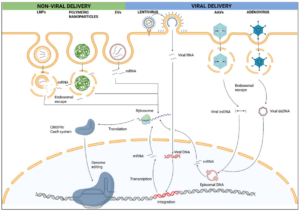
Viral vectors benefit from biological mechanisms that have evolved to enter cells and deliver genetic material. AAV vectors are used very often because different capsids (the shells of the viruses) can target different tissues and support efficient, durable gene expression. They have been investigated extensively in the eye, liver, nervous system, and muscle.
However, AAV can carry only about 4.7 kilobases of genetic material (almost 5000 letters). Large base and prime editors may consequently need to be divided between two vectors and reassembled inside the target cell. AAV exposure can also generate neutralizing antibodies, making repeat administration difficult. In a genome-editing setting, researchers must additionally consider persistent editor expression and the possibility that vector sequences may integrate at CRISPR-induced DNA breaks.
Other kinds of viral vectors that can be used, are Adenoviral vectors and Lentiviral vectors. Adenoviral vectors represent a separate class of viral delivery vehicles from AAVs. They can accommodate much larger cargo and can deliver complex editing systems within one vector. Their principal limitations are immune activation, pre-existing immunity (because they are responsible for common colds, sore throats and other mild infections) and potential toxicity (since even if you never had a disease caused by adenovirus, your body will react to the use of their capsids). Lentiviral vectors offer efficient and sustained delivery but commonly integrate genetic material into the host genome. This makes them particularly valuable for established ex vivo applications, although direct in vivo use requires careful control of integration and prolonged CRISPR expression.
Non-viral carriers offer a different balance. LNPs can transport messenger RNA and guide RNA, producing a transient “hit-and-run” period of editing. Their modular composition, scalable production, and potential for repeat administration make them attractive for clinical development. Their greatest success has been in the liver, where intravenously delivered LNPs naturally accumulate. Reaching other organs and specific cell populations remains more difficult, although changes in lipid composition, surface charge and targeting ligands are beginning to redirect these nanoparticles towards the lung, spleen, immune cells, bone and other tissues.
Extracellular vesicles and virus-like particles seek to combine biological delivery efficiency with transient cargo exposure. Synthetic polymers, gold particles, silica nanocapsules and other engineered materials provide further flexibility in cargo loading, targeting, and controlled release. Nevertheless, each introduces questions concerning reproducibility, biodegradability, long-term accumulation, toxicity, and manufacturing at a clinical scale.
No delivery platform is universally superior. AAV may be appropriate when durable expression and established tissue tropism (Remember? The tendency of a delivery vehicle to accumulate in or enter particular organs and cell types) are priorities. A LNP may be preferable when transient exposure (or temporary activity), scalable production or redosing is important. A virus-like particle may offer DNA-free delivery of a complete editing complex. The appropriate choice depends on the disease, target cell, editor size, required duration of activity and acceptable level of risk.
Every organ is a different delivery problem
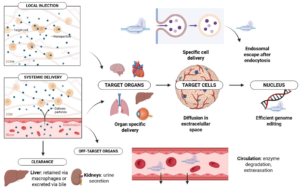
The human body cannot be treated as a uniform environment. Delivering genome-editing tools to the right cells is far from straightforward. After administration, the vector must travel through the body, reach the target tissue, enter the correct cells, and release their genetic cargo before genome editors can have a therapeutic effect. Local administration can help focus the treatment on a specific area, but it often requires more invasive procedures and may not reach all affected cells.
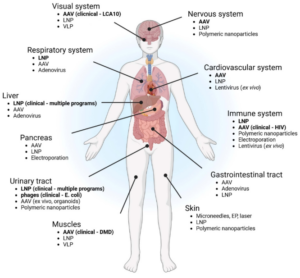
The liver is currently the leading organ for systemic in vivo editing. Its physiology favors nanoparticle uptake, and LNP-delivered CRISPR systems are being investigated for transthyretin amyloidosis, hereditary angioedema, lipid disorders and rare metabolic diseases. Liver-directed editing could turn some treatments that currently require lifelong medication into durable interventions following one or a small number of doses. At the same time, recent clinical experience reinforces the need for careful liver monitoring and rigorous assessment of dose-related toxicity.
The eye offers another important route to translation. Its compartmentalized anatomy allows local delivery, and its relative “immune privilege” (the eye has evolved mechanisms that limit immune responses in order to preserve vision) can reduce systemic exposure. AAV-mediated CRISPR editing has already reached clinical testing for an inherited retinal disease. However, subretinal administration is invasive, photoreceptors can be difficult to target and persistent editor expression requires long-term safety evaluation.
Targeting the nervous system presents numerous challenges: Passing the formidable blood-brain barrier, limited neuronal regeneration and a strong need to avoid inflammation. AAV remains the most established delivery platform, while lipid nanoparticles, peptides, focused ultrasound and intranasal approaches are being investigated as less invasive alternatives. For muscle, widespread distribution across a large tissue mass is necessary, whereas respiratory delivery must overcome mucus, airway clearance, immune cells, and the physical stresses of nebulization.
From scientific achievement to accessible treatment
In vivo editing could simplify treatment by avoiding cell collection, laboratory modification, and reinfusion. This is especially relevant for patients who cannot access highly specialized cell-processing facilities. It may also support therapies for organs whose cells cannot be easily removed and transplanted back.
One striking example discussed in the review is a personalized base-editing treatment developed for an infant with severe carbamoyl-phosphate synthetase 1 deficiency. The CRISPR editor was delivered to the liver using LNPs and was designed for that patient’s specific disease-causing variant. This case demonstrated the potential for individualized in vivo editing in an ultrarare, life-threatening disease. It also highlighted the regulatory, manufacturing, and economic questions that arise when a therapy may be intended for only one person.
As genome editing moves from rare and severe conditions towards chronic or preventive indications, expectations will become even stricter. A patient facing an otherwise untreatable disease may reasonably accept risks that would not be acceptable for a preventive treatment in an otherwise healthy person. Developers must therefore connect editing efficiency with biodistribution, immune responses, unintended genomic changes, long-term follow-up and reliable manufacturing.
European and United States regulatory frameworks increasingly require detailed characterization of where delivery systems travel, how long they persist and whether editing occurs outside the target tissue. Manufacturing is equally important. Particle size, cargo encapsulation, vector purity, potency, and batch consistency can all influence clinical outcomes. Delivery innovation must consequently advance alongside analytical methods, regulatory science, and scalable production.
The next breakthrough may be the vehicle
The review’s central conclusion is clear: in vivo genome editing is becoming a delivery-governed discipline. Better editors remain important, but their clinical impact will depend on vectors and particles that can reach selected cell populations, release their cargo efficiently, limit exposure elsewhere and be manufactured consistently.
Progress will require collaboration across molecular biology, materials science, immunology, clinical medicine, manufacturing and regulation. It must also be accompanied by long-term safety studies, responsible animal research, accessible production models, and ensuring these life-saving new therapies are widely accessible to those who need them. Finally, careful consideration of who will ultimately benefit from these therapies will be key to progress the use of CRISPR beyond it’s current state.
CTGCT thanks Duško Lainšček and Tjaša Lapanja (who helped write this breakdown) and all contributors to the GenE-HumDi COST Action review for bringing together the rapidly expanding evidence across editing technologies, delivery platforms, organ systems and clinical development. Their work provides researchers, clinicians and policymakers with a valuable framework for turning CRISPR’s molecular precision into safe, durable and broadly accessible therapies.
This article is based in the review paper by Martin, L., Bohinc, J., Recchia, A., Gritti, S., Santilli, G., Zeyland, J., Vidaković, M., Grdović, N., Benabdellah, K., Ortiz-Bueno, M., Butuner, B. D., Pisaniello, L., Stilhano, R., Benati, D., Hapil, F. Z., Khawaja, S., Nair, R. R., Giacomelli, C., Atilla, E., … Lainšček, D. (2026).Titled “In vivo delivery strategies for therapeutic CRISPR genome editing”. Published in the International journal of biological sciences (Vol. 22, Issue 12, pp. 6539–6581). https://doi.org/10.7150/ijbs.133162