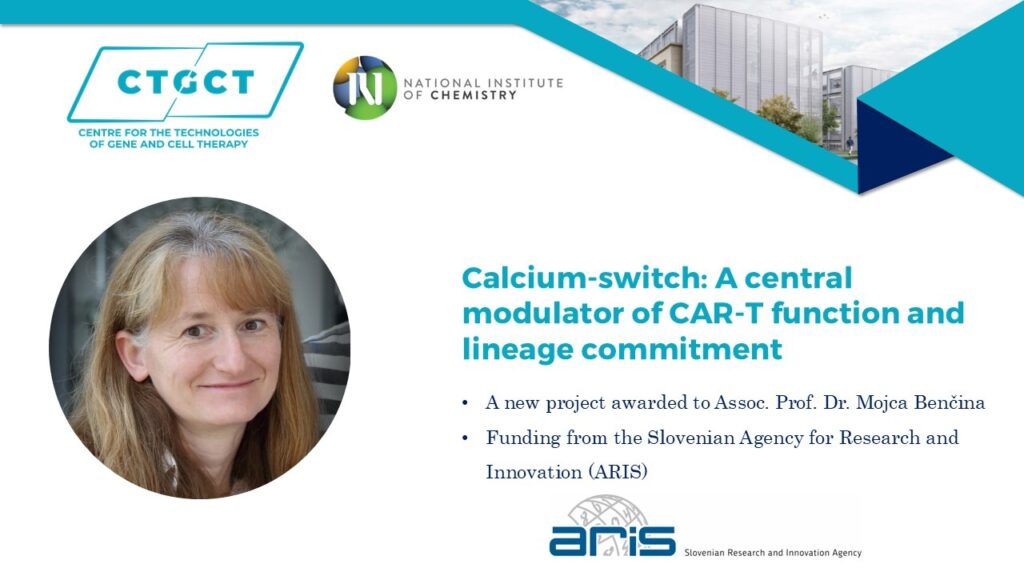
As part of our efforts towards the sustainability of the CTGCT and with the goal in mind to develop new gene and cell therapies for cancer and rare diseases, our team members are applying to several grant call on the Slovenian and European level while trying to collaborate with industry. In this occasion we want to celebrate that the Head of the CTGCT, Assoc. Prof. Dr. Mojca Benčina has received an ARIS project grant this year.
Calcium-switch: A central modulator of CAR-T function and lineage commitment
The landscape of cancer treatment has evolved a lot since the first CAR-T cell therapies were developed. CAR-T therapies are a method that effectively turns part of a patient’s own immune system into a precision-guided strike force. While this technology has achieved remarkable success in treating blood cancers, solid tumors remain a formidable challenge. The solid tumors are like “cellular fortresses”, often exhausting engineered T cells before they can finish the job. At the Centre for the Technologies of Gene and Cell Therapy (CTGCT), we are embarking on an ambitious new chapter called Project Calcium-switch. This project aims to introduce a dynamic, reversible control system that preserves T cell fitness to continue fighting cancer cells while ensuring long-term protection against relapse.
Key Concepts
To better understand the mechanics of this project, it is helpful to define the specialized language of this frontier science:
-
CAR T: Chimeric Antigen Receptor T cells are laboratory-modified immune cells equipped with a synthetic receptor that allows them to recognize and bind to specific cellular markers found only on the surface of cancer cells.
-
Phenotype: This refers to the observable characteristics and behaviors of a cell, which are determined by how its genes interact with the environment.
-
Memory Phenotype: These are T cells that act like seasoned veterans; rather than burning out in a single fight, they possess the longevity to stay in the body for years, providing a “living memory” that reacts if the cancer returns.
-
Sonogenetics: An innovative field that uses ultrasound waves to trigger specific biological activities within a cell, allowing us to “turn on” or “turn off” functions using ultrasound rather than drugs.
The Challenge of the Solid Tumor Fortress
While CAR-T therapy has seen remission rates as high as 80% in certain leukemias, solid tumors, like those found in the lung, breast, or pancreas, present a much harsher environment. These tumors are protected by physical barriers and chemical signals that actively suppress the immune system. When CAR-T cells enter these environments, they are often forced into a state of persistent activation. This relentless “on” signal leads to terminal differentiation, a process where the T cell becomes an over-specialized effector cell that quickly wears out and dies. This “exhaustion” is the primary reason why early clinical trials for solid tumors have struggled, often resulting in low response rates and frequent relapses.
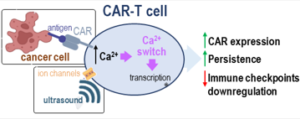
In this project lead by Dr. Benčina, we propose a sophisticated solution to this exhaustion by targeting the cell’s internal signaling machinery. In a natural immune response, the flow of calcium ions acts as a critical messenger. When a T cell detects a threat, calcium levels rise, activating a protein called NFAT, which then enters the nucleus to flip the switch on the genes required for an attack. Our research focuses on building a synthetic calcium switch that allows us to modulate this pathway. By precisely regulating the frequency and intensity of these calcium pulses, we can prevent the T cell from locking into a permanent “exhausted” state. Instead, we can encourage the cells to maintain their memory phenotype, ensuring they remain young, potent, and capable of long-term survival within the hostile tumor microenvironment.
Precision Control Through Sound
What sets this project apart is its dual-activation mechanism. We will add to the cell an external “remote control” through sonogenetics. By engineering T cells that respond to specific ultrasound frequencies, clinicians can potentially trigger a burst of calcium signaling exactly where it is needed most, when it is needed. This provides a level of spatial and temporal control that was previously not possible to our knowledge. We can allow the T cells to “rest” to prevent exhaustion and then use localized ultrasound to “wake them up” once they have successfully infiltrated a tumor site. This targeted approach not only improves the effectiveness of the treatment but also enhances safety by reducing the risk of systemic side effects like cytokine release syndrome.
A Collaborative Path to the Clinic
The journey of this project moves through four rigorous phases, starting with the design of these genetic switches in model cell lines and progressing to validation in primary human T cells. Our ultimate goal is to prove the efficacy of this system in living models, demonstrating that “calcium-switchable” cells can outperform traditional CAR-T therapies in both safety and durability. This work will be a massive collaborative effort, bridging the expertise of the CTGCT with international partners like Charité Berlin, UCL London, and the University Medical Centre Ljubljana.
We look forward to continuing with the advances shown by Assoc. Prof. Dr.Mojca Benčina and her team in sonogenetics and will continue working towards a novel type of CAR-T therapies that can be activated also with ultrasound stimulation. We also want to thank the Slovenian Research and Innovation Agency (ARIS) for their support and funding. Keep an eye on our page to see the latest news about this project.