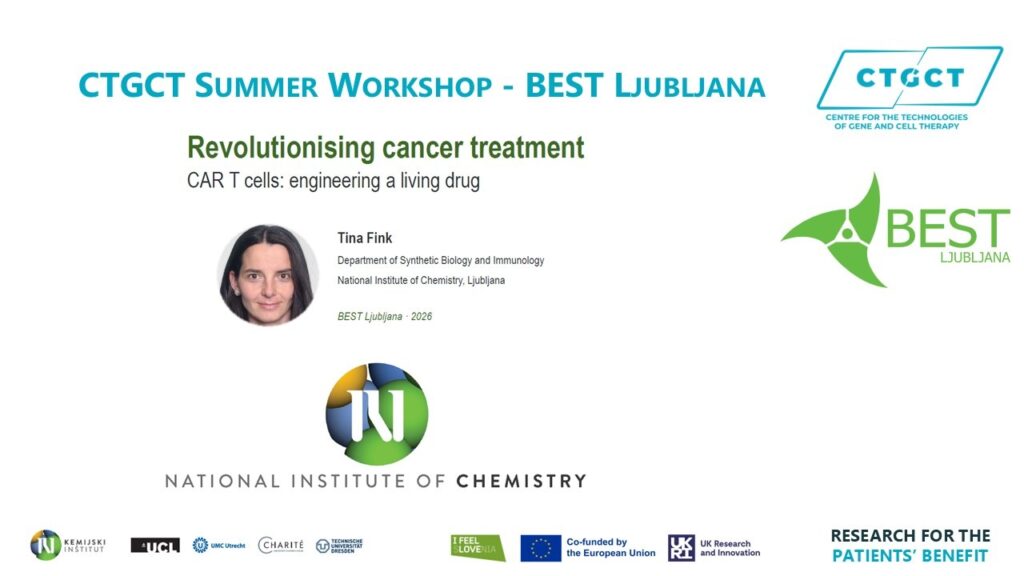
Cancer treatment has undergone a remarkable transformation over the past decade. What if, instead of relying solely on drugs to attack tumors, we could reprogram a patient’s own immune cells to seek out and destroy cancer? This idea, once considered futuristic, is now becoming a clinical reality. CAR-T cell therapy represents one of the most significant breakthroughs in modern immunotherapy, offering new hope to patients with otherwise untreatable cancers.
During a recent lecture at the Summer Course organized by us and BEST Ljubljana, Tina Fink from the National Institute of Chemistry explored how CAR-T cells emerged from decades of immunology research and why they are reshaping the future of cancer treatment. This is the first article of a series of five where we summarise the presentations given by our colleagues. Tina Fink’s presentation also highlighted ongoing efforts in Slovenia, including activities within CTGCT, to make these advanced therapies more accessible and affordable.
Key concepts: understanding CAR-T therapy
Before exploring the technology and its impact, it is helpful to understand a few essential concepts:
- T cells: A type of white blood cell. T cells are part of the immune system and develop from stem cells in the bone marrow. They help protect the body from infection and may help fight cancer. Also called T lymphocyte.
- B cells: A type of white blood cell that forms part of the adaptive immune system. B cells produce antibodies that recognize specific threats and help protect the body from infection. Because some blood cancers arise from B cells, CAR-T therapies can be engineered to identify molecules on their surface, such as CD19 or BCMA, and eliminate both cancerous and healthy B cells.
- Immunotherapy: Treatments that enhance or redirect the body’s own immune system to fight disease.
- CAR (Chimeric Antigen Receptor): An engineered receptor introduced into T cells that enables them to recognize specific molecules on cancer cells.
- CAR-T cells: Patient-derived T cells that have been genetically modified to express a CAR and then reinfused into the patient.
- Cytokine Release Syndrome (CRS): An inflammatory reaction caused by widespread immune activation following CAR-T treatment. It is one of the most important side effects associated with this type of therapy.
- Solid tumors: Cancers that form masses in organs or tissues. Unlike blood cancers, they present additional challenges for CAR-T therapies.
Reprogramming the immune system
The immune system is already equipped with powerful mechanisms for identifying and eliminating threats. However, many cancer cells develop ways to evade immune surveillance. CAR-T therapy was developed to overcome this limitation by giving T cells an artificial receptor specifically designed to recognize cancer.
Scientists drew inspiration from two natural biological systems. Antibodies are highly effective at recognizing specific targets, while T cells possess powerful machinery for killing abnormal cells. By combining the recognition capability of antibodies with the activation machinery of T cells, researchers created the chimeric antigen receptor. This synthetic receptor allows T cells to directly identify tumor-associated molecules without requiring traditional antigen presentation mechanisms.
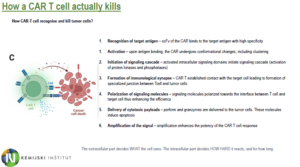
Once a CAR-T cell encounters its target, a cascade of events is triggered. The receptor clusters at the point of contact with the tumor cell, signaling molecules are recruited, and compounds toxic to cells are released to eliminate the cancer cell. Importantly, T cells can also proliferate after they are isolated from the patients blood, genetically modified using viral vectors to express CAR, multiplied in specialized facilities, and returned to the patient. This proliferation enables a long-lasting therapeutic effect that differs fundamentally from conventional drug treatments.
From laboratory concept to clinical breakthrough
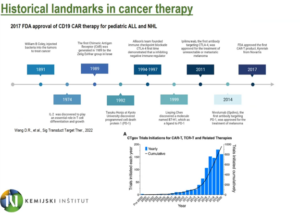
Although the first CAR designs appeared in the 1980s, clinical success took decades to achieve. A major turning point came in 2017 with the approval of the first CAR-T product, demonstrating that engineered immune cells could generate durable responses in patients. The success sparked an explosion of research activity, with nearly 2,000 clinical trials now registered worldwide.
One of the most influential stories in the field is that of Emily Whitehead, a child with relapsed acute lymphoblastic leukemia who became the first patient treated with CAR-T cells at the University of Pennsylvania. Following treatment, she experienced a severe immune reaction that is now recognized as cytokine release syndrome. Doctors managed the complication using the anti-IL-6 antibody tocilizumab, establishing a treatment strategy that has since become standard care. The remarkable outcome demonstrated both the extraordinary potential and the challenges of CAR-T therapy. Emily Whitehead remains cancer-free years after receiving treatment.
Today, approved CAR-T therapies primarily target blood cancers by recognizing molecules such as CD19 and BCMA found on B cells. CD19 and BCMA are proteins found on the surface of B cells. You can think of them as biological “name tags” that help CAR-T cells identify which cells to attack. These treatments have achieved remarkable success in patients who had exhausted multiple previous treatment options. More than 60% of patients in some studies achieved durable responses, representing a major advance for cancers that were previously considered nearly untreatable.
The challenge of manufacturing and access
Despite its clinical success, CAR-T therapy remains difficult and expensive to produce. Manufacturing begins with collection of a patient’s T cells through a procedure called apheresis. The cells are then isolated, genetically modified using viral vectors, expanded in specialized facilities, and returned to the patient. The process typically takes around two weeks and requires dedicated manufacturing equipment for each individual patient.
This highly personalized production model is one of the principal reasons for the therapy’s high cost. Treatment expenses can exceed several hundred thousand euros when hospitalization and intensive monitoring are included. As a result, access varies between countries despite regulatory approval.
To address this challenge, researchers are developing “off-the-shelf” products that could be manufactured in advance rather than individually for each patient. Other groups are exploring even more ambitious approaches, including technologies that generate CAR-T cells directly inside the patient’s body, potentially bypassing complex manufacturing steps altogether. These strategies remain under active investigation, particularly because safety considerations must be carefully addressed.
The next frontier: solid tumors and beyond
While CAR-T therapy has revolutionized treatment of certain blood cancers, solid tumors remain one of the field’s greatest challenges. Unlike blood cancers, solid tumors rarely express perfectly specific targets, increasing the risk of damaging healthy tissues. They also create a suppressive tumor microenvironment that can limit the activity of immune cells.
Researchers are responding with increasingly sophisticated engineering strategies. These include dual-targeting CARs capable of recognizing multiple cancer markers, programmable “logic-gated” CARs that respond only under specific conditions, safety switches that would allow physicians to deactivate the therapy if necessary, and enhanced receptors designed to resist exhaustion. We recommend watching this video about how CAR Ts can be programed to fight cancer.
The technology is also expanding beyond oncology. Because CAR-T cells can efficiently eliminate B cells, researchers are investigating their use for severe autoimmune diseases in which misdirected immune responses drive tissue damage. This illustrates a broader trend in cell therapy: solutions initially developed for cancer may eventually benefit patients with a wide range of chronic diseases.
At the National Institute of Chemistry, scientists are contributing to these advances by redesigning multiple components of CAR receptors, from antigen-recognition domains to signaling elements that determine how strongly and how long the engineered cells respond. Machine learning and protein engineering are increasingly supporting these efforts, creating opportunities for more precise and effective next-generation therapies.
Conclusion
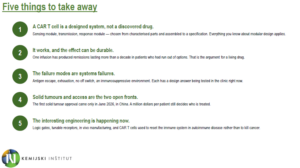
CAR-T therapy has demonstrated that living cells can function as medicines. By reprogramming a patient’s own immune system, researchers have created treatments capable of producing long-lasting responses in cancers that previously had very limited options. Although challenges remain, particularly in manufacturing, cost, and treatment of solid tumors, advances in synthetic biology, gene engineering, and cell therapy continue to accelerate progress.
The field is moving rapidly, and the next generation of CAR-T technologies may make these therapies safer, more affordable, and applicable to many more diseases. We thank Tina Fink for her insightful lecture and for providing a comprehensive overview of one of the most exciting developments in modern biomedical science.