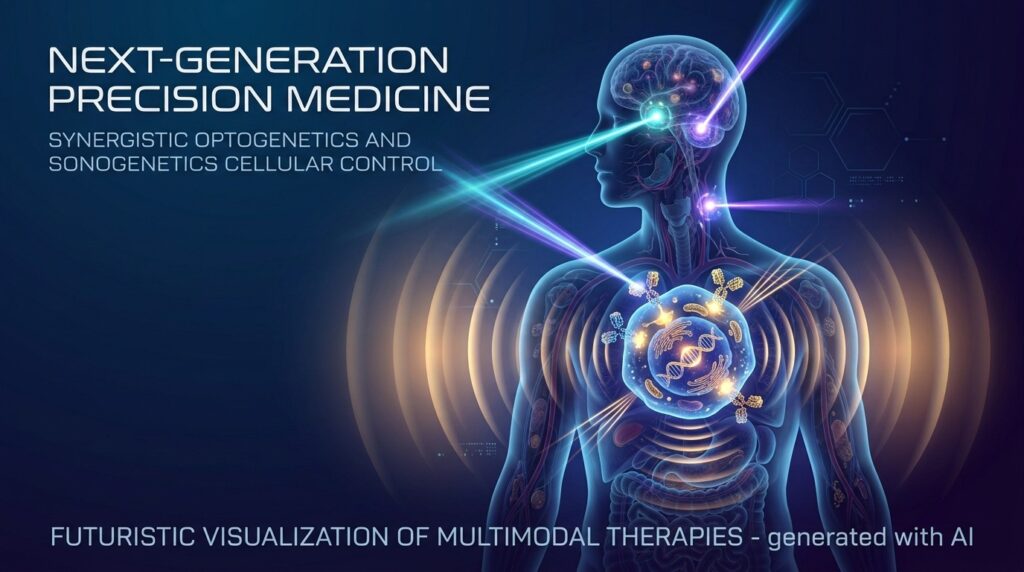
What if scientists could control the activity of cells using nothing more than pulses of light? What sounds like science fiction has become one of the most influential technologies in modern biology. Earlier this week, the 2026 Nobel Prize in Physiology or Medicine was awarded for the development of optogenetics, a breakthrough that has transformed our understanding of how the brain creates memories, processes emotions, and drives behaviour.
The Nobel Prize recognizes the pioneering work of Peter Hegemann, Georg Nagel, and Karl Deisseroth, whose discoveries enabled researchers to control nerve cells using light-sensitive proteins originally found in algae. While optogenetics first revolutionized neuroscience, its impact now extends far beyond the study of the brain. This broader perspective was highlighted last year at the Kemijski Inštitut by a presentation by Prof. Wilfried Weber, who demonstrated how optogenetic tools are being applied in biomaterials, synthetic biology, and future therapeutic technologies. The topic is particularly relevant for CTGCT, where researchers are also exploring innovative methods for remotely controlling cellular behaviour, including the emerging field of sonogenetics.
Understanding Optogenetics
To appreciate why optogenetics has attracted such widespread attention, it is helpful to understand several key concepts:
- Optogenetics: A technology that combines genetics and light to control specific cellular functions with exceptional precision.
- Light-sensitive proteins: Naturally occurring proteins that respond to specific wavelengths of light by changing their activity.
- Photoreceptors: Specialized proteins that detect light and trigger biological responses inside cells.
- Synthetic biology: An interdisciplinary field that designs and engineers biological systems with new or enhanced functions.
- Gene expression: The process through which cells activate specific genes to produce proteins and carry out biological functions.
Together, these technologies allow scientists to control biological processes at precise locations and specific moments in time, providing a level of regulation that is difficult to achieve with conventional drugs or genetic approaches alone.
Beyond the Brain: A New Generation of Light-Controlled Biology
The Nobel Prize-winning discoveries established optogenetics as a revolutionary tool for neuroscience. By enabling researchers to activate or silence individual populations of neurons, scientists gained unprecedented insight into how neural circuits contribute to learning, memory, emotions, and behaviour.
Over time, however, researchers began to realize that the same principles could be applied to many other biological processes. Rather than controlling only neurons, optogenetic systems can now regulate gene expression, direct cell migration, influence cell-to-cell communication, and reshape the properties of biological materials.
During his presentation at Kemijski inštitut, Prof. Weber showcased how light-responsive proteins can be integrated into advanced biomaterials and synthetic biological systems. His research demonstrated how light can be used to dynamically alter the properties of hydrogels, control cellular adhesion, regulate molecular signaling pathways, and enhance gene expression. These technologies allow researchers to create highly controlled biological environments that more closely mimic the dynamic conditions found within living tissues.
Such advances are particularly relevant for tissue engineering and regenerative medicine, where cells constantly interact with changing physical and chemical cues. By using light as a biological control signal, scientists can adjust these cues in real time, opening new possibilities for studying cellular behaviour and designing future therapies.
From Light to Sound: Expanding the Ways We Control Cells
The success of optogenetics has inspired a broader scientific effort to develop technologies capable of controlling cells using external physical signals. Light was the first major breakthrough, but researchers are increasingly investigating alternative approaches that may offer advantages in specific therapeutic settings.
One such approach is sonogenetics, which uses ultrasound instead of light to regulate cellular functions. Like optogenetics, sonogenetics enables remote control of biological activity with high precision. However, because ultrasound waves can penetrate much deeper into tissues than light, the technology may overcome some of the practical limitations associated with delivering optical signals inside the body.
This is an area where some of our colleagues at the CTGCT are experts and have already contributed important advances. We have published research demonstrating sonogenetic approaches for deep-tissue cellular control, as well as a comprehensive review exploring the current state and future potential of the field. These studies investigate how ultrasound can be used to activate engineered cellular systems, opening new opportunities for non-invasive therapies and gene delivery strategies.
Both optogenetics and sonogenetics share the same overarching goal: enabling researchers and clinicians to activate biological processes exactly where and when they are needed. Such precise control could improve the safety and effectiveness of future gene and cell therapies, reduce unwanted side effects, and create new treatment possibilities for cancer, rare diseases, and neurological disorders.
The emergence of sonogenetics illustrates how the Nobel Prize-winning foundations of optogenetics continue to inspire entirely new research directions. What began as a neuroscience tool has evolved into a broader technological platform for programming cellular behaviour through external signals.
Precision Control for Future Therapies
One of the most promising aspects of optogenetics is its potential for medical applications. Traditional treatments often affect healthy and diseased tissues simultaneously, which can limit their effectiveness and lead to unwanted side effects. Optogenetic systems offer a fundamentally different approach by providing precise spatial and temporal control over therapeutic activity.
Researchers envision using light-controlled biological circuits to regulate therapeutic genes, activate immune cells, or trigger the release of therapeutic molecules only at specific locations within the body. Such precision could significantly improve the safety profile of advanced therapies while enhancing their effectiveness.
As scientists continue to discover and engineer new light-sensitive proteins with improved performance, the optogenetic toolbox continues to expand. Beyond medicine, these technologies are finding applications in bioengineering, drug discovery, advanced biomaterials, and even biological computing. Together, these developments are helping reshape how researchers interact with living systems.
Conclusion
The 2026 Nobel Prize in Physiology or Medicine recognizes a discovery that fundamentally changed how scientists study and control biological processes. Originally developed to help researchers understand neural circuits, optogenetics has since found applications far beyond neuroscience. At the same time, ongoing research by CTGCT colleagues in sonogenetics highlights how the principles pioneered by optogenetics continue to inspire new technologies capable of controlling cellular behaviour through different physical signals. Whether through light, sound, or other emerging approaches, researchers are moving closer to a future in which biological systems can be programmed and regulated with unprecedented precision.