A gene therapy may begin with an elegant idea: deliver a genetic instruction to the right cells and change how they behave. Yet between that idea and a treatment lies an enormous manufacturing challenge. The delivery vehicle must be produced by living cells, separated from biological impurities, tested for quality, and manufactured consistently. Even a small difference in acidity, temperature, raw materials, or sampling technique can affect the final product.
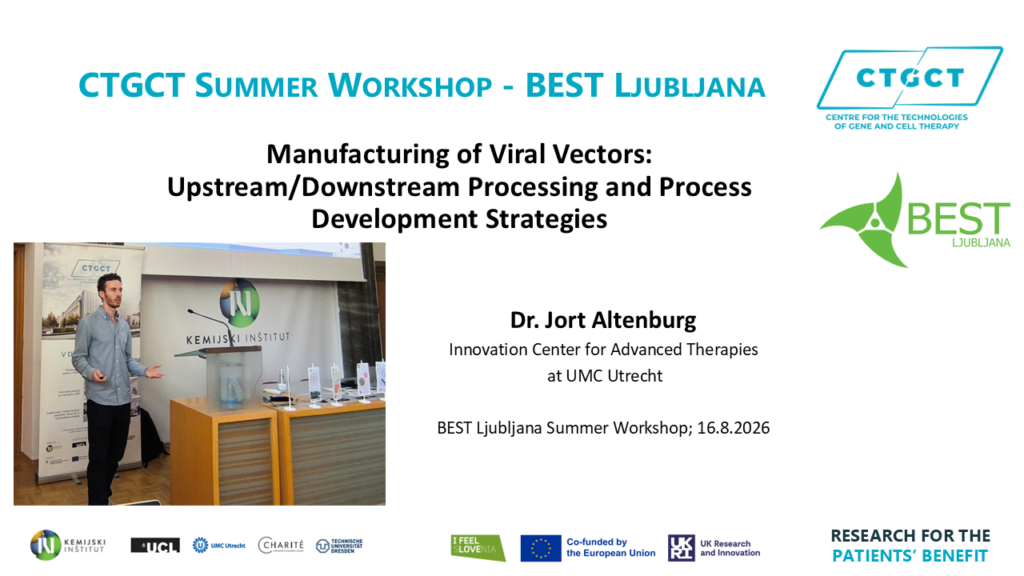
In his lecture we organised during the CTGCT Summer Workshop in collaboration with BEST Ljubljana, Jort Altenburg from the Innovation Center for Advanced Therapies at UMC Utrecht introduced the manufacturing of viral vectors, with particular attention to upstream and downstream processing. He explained why viral-vector production remains a bottleneck for many gene and cell therapies, and how engineering, automation, quality control, regulation, intellectual property, and economic planning must work together to move a promising laboratory result towards patients.
Key concepts for understanding viral-vector manufacturing
- Viral vector: A modified virus used to deliver genetic material into a cell. It is designed to perform a useful delivery function without causing the disease associated with the original virus.
- In vivo gene delivery: A treatment approach in which a delivery system, such as a viral vector, is introduced directly into a patient to reach target cells inside the body.
- Ex vivo cell engineering: A process in which cells are collected from a patient or donor, genetically modified in a controlled environment, and then administered to a patient.
- Upstream processing: The part of manufacturing in which living cells are thawed, expanded, cultivated, and encouraged to produce the desired biological product.
- Downstream processing: The recovery and purification of the product after it has been produced. It may include clarification, filtration, chromatography, concentration, and formulation.
- Bioreactor: A controlled vessel in which cells or microorganisms are cultivated. It allows manufacturers to monitor and adjust environmental conditions more precisely than is normally possible in a laboratory flask.
- Adherent and suspension cells: Adherent cells require a surface on which to grow, while suspension cells grow freely in liquid. This distinction affects equipment, labour requirements, contamination risks, and scalability.
- Transient transfection: A production method in which genetic instructions, often carried by several plasmids, are temporarily introduced into producer cells. The cells then use those instructions to assemble viral-vector particles.
- Producer cell line: A cell line engineered to contain some or all of the genetic information needed to produce a viral vector.
- Process analytical technology, or PAT: Sensors and analytical tools used to observe a manufacturing process while it is taking place. PAT can help identify deviations before the final product is completed.
- Potency: A measure of whether a biological product performs its intended function. A batch may contain many vector particles, but quantity alone does not establish whether those particles can deliver genetic material effectively.
- Good Manufacturing Practice, or GMP: A system of controlled manufacturing requirements intended to ensure that medicinal products are produced consistently, safely, and with appropriate documentation and traceability.
From biological delivery vehicle to manufactured product
Viruses have naturally evolved mechanisms for entering cells and transferring genetic material. Gene therapy researchers adapt these mechanisms to deliver therapeutic instructions. Depending on the application, a viral vector may carry a functioning copy of a gene, instructions for producing a therapeutic protein, or genetic information that gives an immune cell a new target-recognition system.
Several types of viral vector are used in research and clinical development, including lentiviral, retroviral, adenoviral, and adeno-associated viral vectors. Each has different biological and manufacturing characteristics, so no single vector is suitable for every application. The amount of genetic material it can carry, the cells it can reach, the duration of gene expression, its safety profile, and the available manufacturing expertise can all influence the choice.
In ex vivo cell therapy, viral vectors can be used to engineer immune cells. Cells are collected, modified outside the body, expanded, tested, and then administered to the patient. This principle supports therapies in which T cells are equipped with receptors that help them identify diseased cells. The lecture discussed both CAR-T therapies and T-cell receptor-based approaches, including their possible relevance to the treatment of solid tumours. If you would like to learn more about CAR T in particular, we recommend reading the article Living Medicines: The Promise and Challenges of CAR-T Therapy by Dr. Tina Fink, which is part of our collection based on this CTGCT Summer Workshop.
Researchers are also investigating lipid nanoparticles, electroporation, and other non-viral systems as delivery vectors. Different delivery technologies have different limitations concerning cargo size, cellular targeting, durability, safety, and manufacturing complexity. The most appropriate technology therefore depends on the therapeutic objective.

Viral vectors can be highly effective, but they are biologically complex and difficult to manufacture. Their quality cannot be determined through visual inspection. Manufacturers need several analytical tests to establish whether a batch has the correct identity, purity, quantity, and biological activity.
This leads to one of the central lessons of biological manufacturing: the process is closely connected to the product. A conventional chemical compound may be described largely through its molecular structure. A viral vector or cell-based product is more dependent on the living system, raw materials, environmental conditions, and sequence of operations used to make it. If the process changes, the characteristics of the product may change as well.
Manufacturing typically starts with a small vial of frozen cells from a cell bank. The cells are thawed and gradually expanded through increasingly large culture systems. Moving directly from a small vial into a large production vessel would not provide an appropriate starting cell density, so several expansion stages are needed before the production bioreactor can be inoculated.
The choice between adherent and suspension cells affects the entire process. Adherent cells require surfaces such as flasks, carriers, or fixed-bed structures. This can increase manual handling and make scale-up more complicated. Suspension cells can often be grown in stirred bioreactors and may be easier to expand to larger volumes. A method that is convenient for early research can therefore become labour-intensive and expensive when production must support clinical trials or larger patient populations.
Vector production often involves introducing several plasmids into producer cells. Each plasmid may supply a different component, such as the therapeutic sequence, structural proteins, or the vector envelope. Manufacturers must determine suitable plasmid ratios, quantities, timing, cell densities, and culture conditions. Every additional input introduces another source of variability that must be understood and controlled.
Stable packaging or producer cell lines could simplify production by placing some or all of the required genetic components inside the cells in advance. This may reduce material costs and process variability. However, establishing, characterising, licensing, and regulating such cell lines presents challenges of its own.
Once production is complete, downstream purification begins. The harvested material contains the desired vector together with cells, cell fragments, proteins, nucleic acids, culture-medium components, and other impurities. A sequence of operations is used to remove unwanted material, capture and concentrate the vector, and prepare it for storage or clinical use.
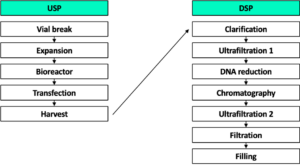
Each purification step can improve purity, but it can also cause product loss or reduce biological activity. Adding more stages is therefore not automatically better. Process developers must decide which operations are essential and which can be removed while still meeting quality and safety requirements. A shorter process may improve recovery, reduce costs, shorten production, and make transfer to another manufacturing site easier.
Controlling variation through engineering, automation, and data
Living cells are sensitive to their environment. Small differences in temperature, pH, oxygen, nutrients, sampling, or raw materials can affect their growth and the product they make. Manufacturing processes must therefore be defined precisely to achieve consistent results across batches, operators, equipment, and sites.
Jort demonstrated this with an investigation involving two manufacturing sites that used different methods to collect samples for pH measurement. One used a syringe that limited contact with air, while the other used a sampling bag that allowed carbon dioxide to escape. The resulting difference in pH was small, but it affected process control and a quality attribute of the final product. Identifying the cause took months.
In another example, a potential vaccine production process was transferred from laboratory flasks to a bioreactor. A pH shift that had previously been assessed using indicator paper was then applied under the more precise pH control of the bioreactor. As a result, the cells rapidly lost viability. Continuous monitoring revealed the cause and helped distinguish a process mismatch in pH measurement from contamination. This illustrates how analytical methods used during discovery may not translate directly to a controlled production environment, underscoring the importance of developing processes under representative production conditions early in development.
Raw materials can also vary between production lots. Jort described how variation in a culture-medium component affected large-scale manufacturing. Researchers subsequently used a small-scale bioreactor model to test new material lots before introducing them into commercial production.
These examples show that reproducibility requires more than a general protocol. Manufacturers must identify critical variables, define how they are measured, and establish acceptable operating ranges. Failures can waste weeks of work, expensive materials, and valuable manufacturing capacity. For patients awaiting individualised therapies, they may also delay treatment.
Process development therefore relies on carefully designed experiments. Miniature bioreactors allow researchers to compare conditions such as temperature, pH, oxygen, and cell density while using less material than production-scale systems. Automated handling can further improve consistency. However, small-scale models must reproduce the important features of full-scale manufacturing if their results are to remain relevant.
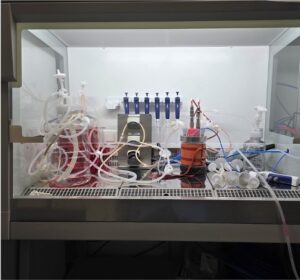
Online sensors and imaging systems can provide continuous information about cells and process conditions without frequent manual sampling. Combined with machine learning, these tools may help estimate cell numbers, assess viability, and detect problems earlier. If the data indicates that a batch is unlikely to meet quality requirements, operators may be able to intervene or stop production before more resources are wasted.
Data-driven models can also guide experimental design by identifying the most informative conditions to test. However, automation and artificial intelligence cannot replace biological and engineering expertise. Their value lies in helping multidisciplinary teams design better experiments, recognise deviations earlier, and use limited resources more effectively.
Manufacturing choices determine affordability and access
Process development is not only a technical exercise. Early decisions about cell lines, materials, equipment, analytical tests, and intellectual property can determine whether a therapy remains affordable and commercially viable. Some decisions become difficult to change after clinical development has started. A revised manufacturing process may produce a product that is no longer considered sufficiently comparable to the version originally tested. Developers may then need to conduct additional analytical or clinical studies, increasing costs and delaying patient access.
Cell-line licensing is one example. A cell line that is suitable for laboratory research may not be licensed or sufficiently characterised for clinical manufacturing. A commercially available production cell line may require upfront fees, annual payments, restrictions on modification, or royalties if the therapy reaches the market. These conditions may be manageable for a large pharmaceutical company but can present a substantial obstacle for a university, hospital, or small biotechnology company.
Plasmids and other GMP-grade materials can also be expensive. Reducing the number of plasmids, developing stable producer cells, or improving vector yield may lower costs. However, the most productive technical system is not always the best overall option if it comes with restrictive intellectual-property conditions, difficult regulatory requirements, or dependence on a single supplier.
Manufacturers must also select an appropriate operating mode. A batch process begins with a defined quantity of material and is harvested after a set production period. Fed-batch processing adds nutrients during cultivation, while perfusion systems retain the cells and continuously replace spent medium. Perfusion may increase productivity within a limited reactor volume, but it introduces additional equipment, controls, and regulatory complexity.
More productive and compact systems could support regional or decentralised manufacturing. Smaller facilities may be valuable when a product is unstable, requires an extremely cold supply chain, or must reach patients quickly. Distributed manufacturing could also improve resilience by reducing dependence on a single production site. However, every location would need to demonstrate that it can manufacture a comparable product.
Time is critical for patient-specific cell therapies, which require cells to be collected, transported, modified, tested, and returned to the patient. Closed and automated platforms could shorten this process, reduce contamination risks, and support manufacturing closer to hospitals without compromising safety or quality.
However, even an effective therapy may remain inaccessible if it is too expensive or difficult to manufacture at scale. Affordability must therefore be considered early by researchers, regulators, manufacturers, investors, and healthcare providers.
Clinical translation also requires collaboration among biologists, engineers, clinicians, analytical scientists, and regulatory and financial specialists. Each brings different priorities, from potency and safety to scalability, licensing, and cost. The goal is not to optimise a single variable, but to balance these demands and create therapies that are safe, effective, and accessible.
Conclusion
Viral vectors provide an important bridge between genetic knowledge and therapeutic action. They can deliver new instructions directly into the body or modify cells outside the patient before those cells are administered as treatment. Their potential, however, depends on the ability to manufacture them safely, consistently, and at an appropriate cost.
Achieving this requires more than increasing the number of vector particles produced. Developers must select suitable cells and materials, control cultivation conditions, purify the vector without damaging it, establish meaningful analytical tests, and understand how small process changes affect quality. Automation, miniature bioreactors, continuous sensors, and data-driven models can accelerate this work, but they must be supported by biological understanding and carefully designed experiments.
Manufacturing strategy will ultimately influence which therapies reach patients and who can access them. A scientifically promising treatment may remain in the laboratory if its production process is unreliable, its materials are prohibitively expensive, or its intellectual-property conditions discourage further investment. Designing for scalability, affordability, and regulatory compliance from the beginning is therefore part of therapeutic innovation itself.
Finally, from the CTGCT team we want to thank Jort Altenburg for presenting a practical and wide-ranging account of viral-vector manufacturing and for demonstrating how process engineering connects laboratory research with clinical translation, industrial production, and patient access.