When gene therapy works, the headline is often the “fix”, a gene delivered, a pathway restored. But what really moves a therapy toward patients is everything around that headline: controlled expression, biodistribution, long-term monitoring, and regulator-ready safety evidence.
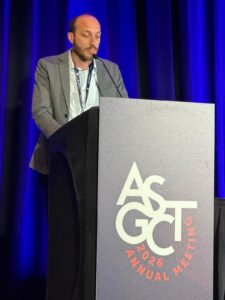
At the ASGCT 2026 Annual Meeting in Boston (May 11–15, 2026), held held in Boston, Massachusetts, USA, our colleague Dr. Duško Lainšček presented two pieces of work that reflect this translational reality. One of his presentations highlighted research advancing the AAV9 gene therapy for CTNNB1 syndrome.
Main highlight: Development of an AAV9-mediated gene therapy for the CTNNB1 Syndrome
The CTNNB1 syndrome is severe and largely untreatable, and its monogenic nature makes it a strong candidate for gene-based intervention. However, the biology around the main protein, β‑catenin, that causes the syndrome requires caution: therapeutic expression must restore function without activating oncogenic signaling programs.
The team involved in the research presented (which was led by the CTNNB1 Foundation) treated CTNNB1 gene therapy as a control problem, not just a delivery problem: getting the gene into the brain is important, but getting the right level of expression is just as critical. To find that “sweet spot,” they built six AAV9 versions of the therapy, each using different regulatory DNA to fine‑tune how strongly the therapeutic CTNNB1 would be expressed. They compared these designs first in patient-derived cortical brain organoid, a human-relevant brain model, and selected he lead candidate based on performance.
Because β‑catenin is connected to pathways that can become risky if overstimulated, they also checked that the lead candidate restored function without activating tumor-associated signaling programs and RNA-seq supported the absence of broader oncogenic activation.
They then moved from molecules to behavior: in a Ctnnb1+/- mouse model, the lead therapy improved locomotion and anxiety-like behavior at the highest tested dose. Finally, they assembled a translation-oriented safety package: long follow-up in mice (up to 8 months), GLP toxicology, and non-human primate biodistribution showing broad brain distribution with no significant clinical signs at 90 days. This supported the progression to a Phase I/II trial launched in Slovenia in December 2025 for URBAGEN.
Second presentation: Decoupling reactogenicity from efficacy enables safer mRNA vaccines, AAV gene delivery, and in vivo base editing
Duško’s other ASGCT talk addressed a common limitation of nucleic-acid therapeutics, innate immune sensing that can drive reactogenicity and restrict dosing. The work explored whether transient suppression of early innate sensing could improve safety while preserving efficacy across mRNA vaccines, AAV delivery, and in vivo base editing (as described in the submitted abstract text).
About the conference Duško emphasized how ASGCT 2026 sharpened focus on what enables real-world translation: delivery systems, gene editing advances, safety, biodistribution, immunogenicity, regulatory (EMA/FDA) expectations, and manufacturing—knowledge that will feed directly into CTGCT’s ongoing R&D and collaboration planning.